By Doug Hornig
Paydirt book editor Doug Hornig outlines the 4 key factors that signal why this bull market ain’t over. -Jeff Clark
You may have seen this July 7 headline from Bloomberg, or another like it: Gold’s Bull Market Has Ended and Now All Eyes Are on Bears.
If you hold gold, do you have the jitters? After all, gold fell $610 in March, the absolute largest decline ever for gold in a single month, and a gut-wrencher. As I write on July 30, the gold price is off by some 26% since its peak price in January, and down about 23% since February 28. Keep that date in mind for later.
The question is whether the big, bad bear will continue swatting gold ever further down, or whether we are just enduring a needed but painful correction that proves as relatively short-term as it was steep.
What’s frustrating is that gold doesn’t seem to be doing what, according to historical precedent, it should be doing. In some ways, it’s been completely irrational.
So let’s look at four key factors:
- Demand
- Money supply
- Mining
- And war.
Demand Destruction—Not
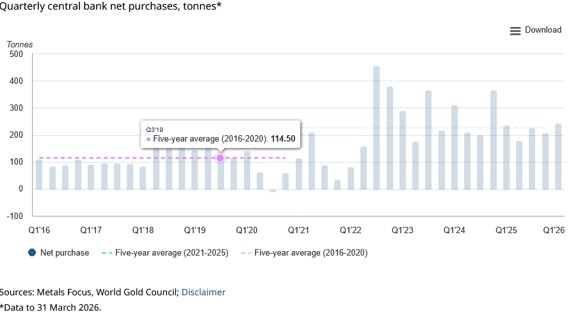
Gold’s falling price suggests that it has experienced demand destruction. Well, not much. Central bank buying remains strong. At 240 tonnes for 1Q26, it remains well above levels prior to late 2022.
The People’s Bank of China added 14.93 tonnes in June alone—its largest single-month addition since 2023—bringing its uninterrupted buying streak to 20 consecutive months. Other countries are also going all-in. Poland, Uzbekistan, and Kazakhstan are adding heavily, and there are even some first timers: Guatemala, Cambodia, and Indonesia. The World Gold Council’s full-year forecast for 2026 is approximately 850 tonnes.
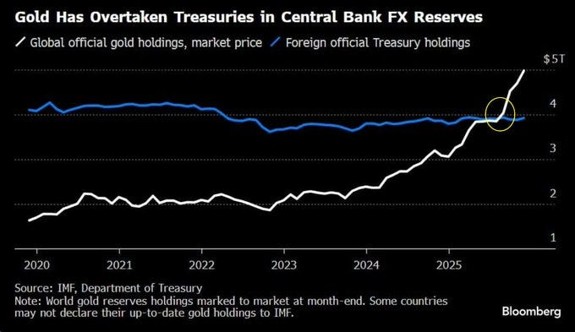
Gold has recently overtaken US Treasuries in world central bank reserves, rising rapidly as you can see.
Incrementum AG’s influential annual publication, In Gold We Trust, had this to say:
Gold has entered “a fully developed public participation phase: The bull market, still supported by central banks during the accumulation phase, is now being shouldered aside by a broader investor base. The bull market has entered the mainstream.”
Demand, it would appear, is alive and well.
Inflation is not Tamed
The money supply? This chart says it all:
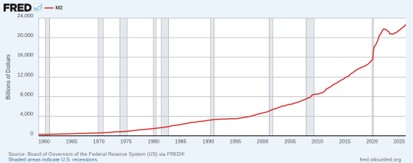
Monetary inflation invariably leads to inflation in goods and services. Which should be bullish for gold. Hasn’t been in ’26.
But it will be.
What Are Miners Doing?
If those who pull gold from an unyielding earth were fearful that we’re in a bear market, they would be paring back their activities accordingly. Lower prices mean falling profits, after all.
That hasn’t happened—just the opposite, in fact. These are the reported combined capital expenditures from Q1 2025 through Q1 2026 by a basket of the largest miners—Newmont, Barrick, Agnico Eagle, and Kinross:
- Q1 2025 – $229 billion
- Q2 2025 – $245B
- Q3 2025 – $263B
- Q4 2025 – $3.07B
- Q1 2026 – $2.48B
The big miners are still investing optimistically in their projects and their growth, relatively unbothered by the price drawdown. They’re voting with their dollars; if they were worried, they’d be pulling back. Another bullish indicator.
Finally, there is the war in Iran, which I’ll come back to in a moment.
So what gives? We can easily see what’s happening. But why?
This is Normal
Gold’s grand bull market, which in my opinion began with the dot.com crash in 2000, has seen a steady trend upward, but it has hardly been unbroken. The price pulled back 30% in 2008, during the Great Financial Crisis. After recovering into 2012, it fell nearly 40% by late 2016. Then it ran higher until Covid, when it lost 27%.
In each instance, the bottoms were the beginnings of the next leg up. What we see today is normal.
The gold market is the sum total of the simultaneous decisions being made by millions of humans and larger trading entities across the planet. The price change is merely the net difference between buyers and sellers. That varies.
Gold’s most recent meteoric rise—about +98% from Jan. 2025 to Feb. 2026—was likely a bit too much, too fast. Investors always have to take profits at some point. Once a correction sets in, it tends to gain momentum, drawing in those who don’t want to miss cashing out their gains. Others may need liquidity to settle trades that have gone against them. (The S&P 500 declined nearly 10% from mid-January to late April.) Gold is often what they first sell to raise cash.
Remember this, too. Ultimately, physical supply and demand set the price. In the twisted modern financial universe, however, the market is hugely subject to the influence of derivatives—futures, options, structured vehicles and so on.
It’s really a casino, where the high rollers play with paper. Layered on top of the speculators who day-trade paper gold are the major institutional longs—banks, hedge funds, NGOs, pension funds, etc.—for whom gold is a core part of their portfolios. They have to answer to their investors, and can’t afford big hits to their gold holdings.
Many of these entities have algorithms that trigger Sell orders if the metal’s price falls below a certain level. And once the algos start firing, a modest pullback can turn into a rout without a smidge of human intervention.
That’s partly what happened in February, egged on by a perfect storm of gold negatives. The usual suspects:
- A stronger dollar, up around 5.5% since January, making gold more expensive for foreign buyers.
- Rising long bond interest rates, which hurts non-yielding assets like gold.
- The arrival of a new Fed chair who promised to reverse 40 years of easy money and fight inflation by potentially raising the fed funds rate.
The only thing lacking was a spark for the fire sale, and that arrived in the form of the Iran war.
Wars are Unpredictable—and so are Their Effects
Remember February 28? That’s the day the Iran war started, and it marks the exact moment when the precipitous gold selloff began. Coincidence? I quit believing in coincidences long ago.
Wars are the ultimate destabilizers. They induce fear, and they generate a rise in inflation. Shouldn’t the outbreak of war have caused a flood of gold buying, as investors rushed into the world’s traditional safe haven? Sure, it should.
But obviously, in the case of Iran, it didn’t. Investors ran the other way, with no relief outside of a brief blip up the first two weeks of April.
From In Gold We Trust:
- “Following gold’s spectacular rally of the preceding quarters, a consolidation phase was not only likely but, from a technical perspective, overdue. The impetus came from the very event that, by the textbook, should have had the opposite effect: the Iran crisis … the war did not become a catalyst but rather the trigger for a healthy correction.”
But why? I believe there is one critical factor that has been little reported on.
The Oil/Gold Connection
The Persian Gulf petro-states have long enjoyed a steady influx of dollars from their oil sales, amassing mountains of US dollars. Which leaves them with a problem—they have to do something with the surplus cash flow. One solution is to turn the dollars into gold. These nations’ central banks and sovereign wealth funds have been stockpiling it.
With the coming of the war, and the closure of the Strait of Hormuz, that cash flow dried up, with two results:
1) It removed a reliable coterie of large-scale buyers from the market.
2) It created liquidity pressures that turned buyers into sellers, forced into a need to swap gold for greenbacks for their budgets, domestic spending commitments, trade, and economic stabilization.
Put ’em together and you have some significant market pressures—and probably a major contributor to the crash.
Daily revenue losses have been estimated at $700M–$1.2B for the Gulf states collectively, with the UAE, Qatar, Kuwait and Bahrain especially hard hit. They aren’t saying how much gold they’ve sold to fill the void. But it could easily be market moving, by itself. Plus, of course, an influx of big physical sellers contributes psychologically to uncertainty about the bull market.
Panic?
Not me. In the end, I totally agree with Edward Bonner, of the venerable Sprott Global Resource Investments:
“The decline is simply institutions shifting gears. Macro correlations between gold, equities, yields, and the U.S. dollar are near extreme levels—suggesting positioning is heavily dominated by systematic flows.
“However, this dynamic is unlikely to persist. When central banks eventually pivot to stabilize bond markets, gold should respond accordingly—much as it did following similar conditions in 2022.
“In other words, any weakness should be viewed as an opportunity within a broader structural bull market.”
As for the junior miners, they’ve been hammered even worse than gold, with the GDXJ down 37% since Feb. 28. The big miners have not been spared, either. Newmont, for example, is off 28% over the same period despite record cash flow last quarter.
But as I mentioned above, the majors are voting optimistically with their capex spending. To me, this indicates confidence in higher prices—as well as opportunities with the selected juniors we cover.
Speaking of those selected juniors…
On November 5, The Gold Advisor is bringing a number of compelling companies together at the Fairmont Pacific Rim for their inaugural Gold Advisor Network Summit: Positioned for Paydirt.
It’s an opportunity to hear directly from company leadership, ask questions, and get additional perspective from Jeff Clark, Peter Krauth, and The Gold Advisor analyst team.
[LEARN MORE AND REGISTER]